RuneOptimizer
====
# A rune optimizer for Summoners War players #
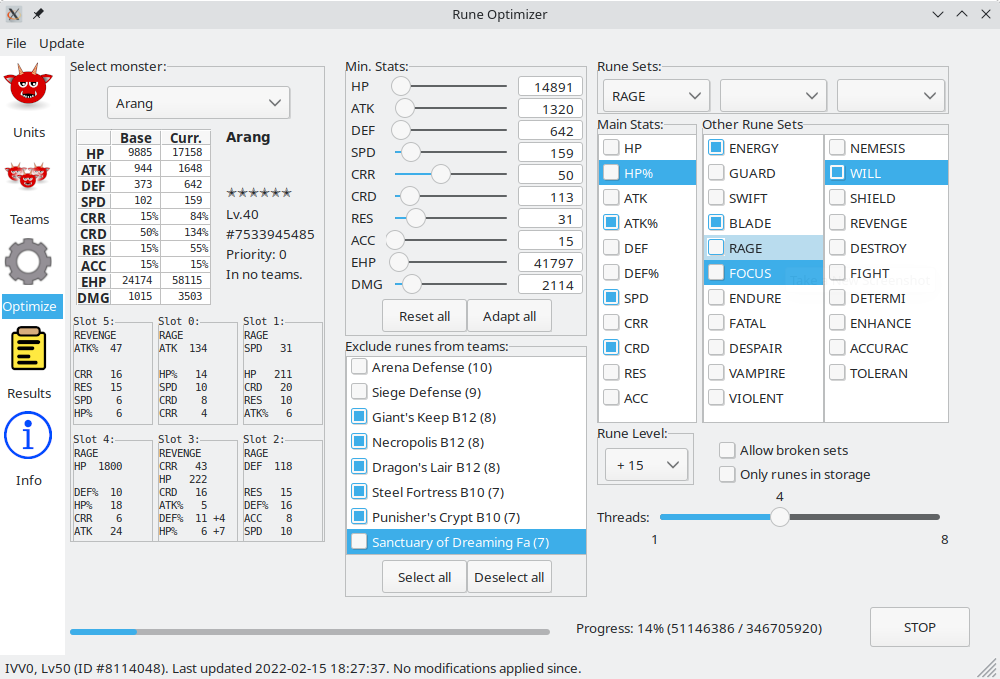
RuneOptimizer is a tool for Summoners War players. It helps players get the
most of their monstesrs and units by calculating rune combinations matching
user-definedcriteria.
It is indeed inspired by Xzandro's
[Summoners War Optimizer](https://tool.swop.one), wich is an amazing tool.
It's not a webapp, but a locally installable application, to get the most out
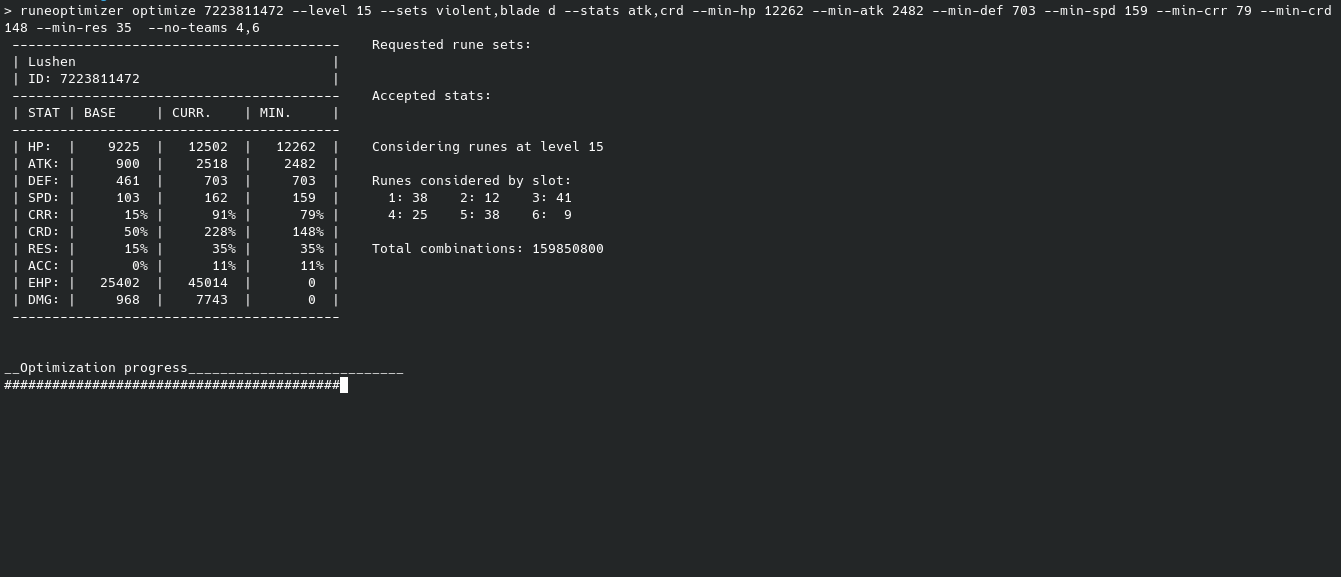
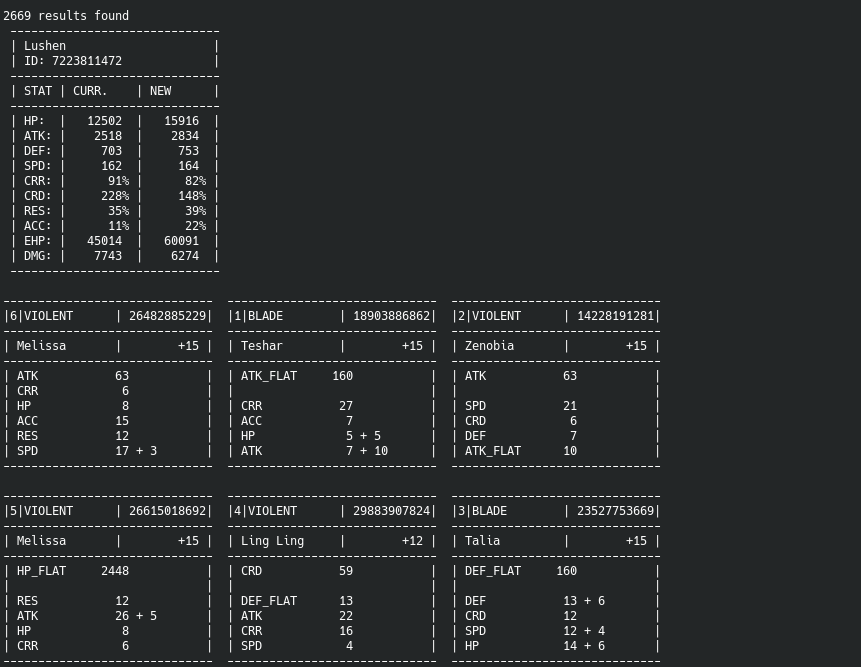
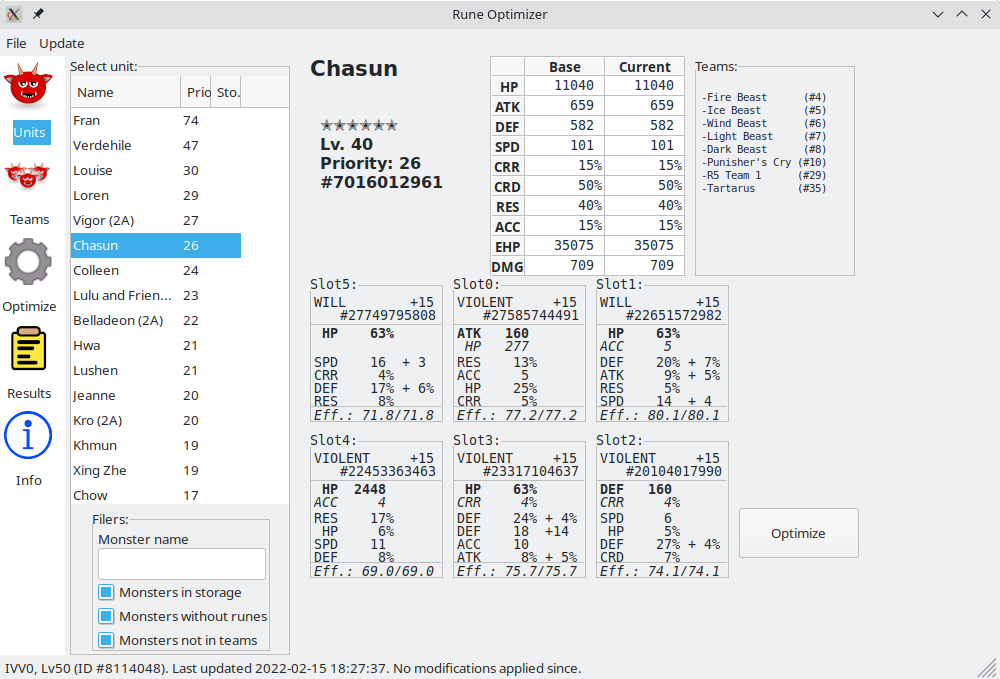
of your CPU. Includes a fully functional command line utility, and a graphical
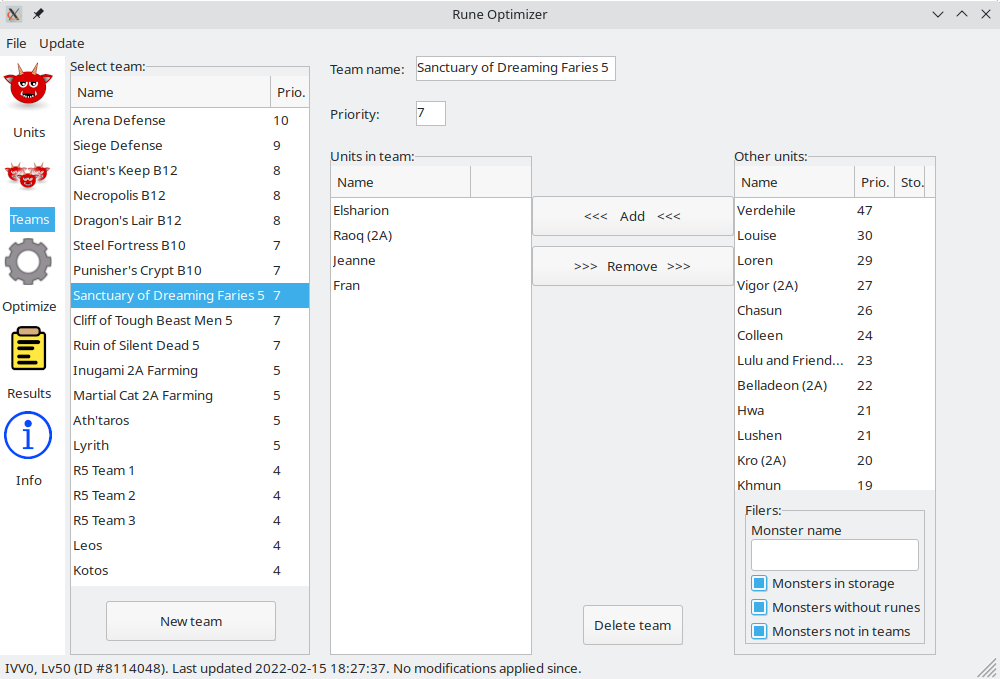
interface for ease-of use.
 ## Features ##
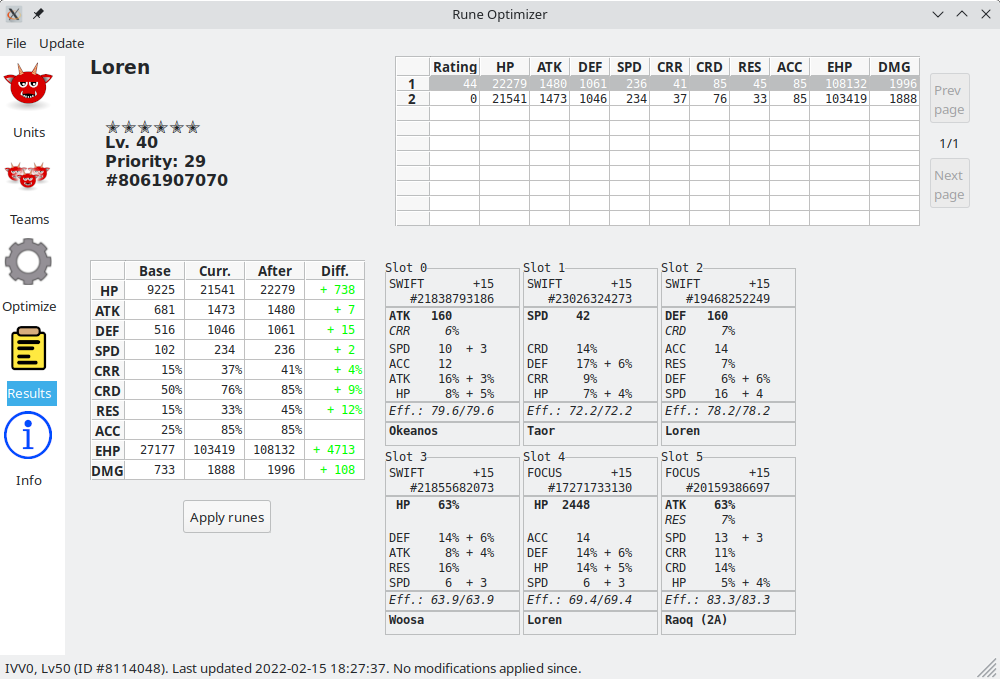
* **Fast:** With multiple threads, it will have the best rune combination for your monster in no time. Roughly speaking, it can calculate a few billion combinations in under a minute on a run-of-the-mill computer.
* **Customizable:** Many options can be selected for optimizations: stats for even slots, required and acceptable rune-sets, using runes from storage, or excluding certain teams or units...
* **Easy:** Just pick a monster. Click 'Optimize'. Wait for the results! While advanced options can also be set, the default ones are an easy way to find out if you can give a quick boost to your monsters.
* **Safe:** No funny moves. RuneOptimizer won't need your login details, and all your data is safely stored locally, and never sent anywhere. In fact, it doesn't eve use the network, all calculations are done locally.
* **Efficient:** It only takes a few megabytes of RAM to run the optimizer.
* **Open Source:** The source code of RuneOptimizer is licensed under a GPL license, and it's publicly available for anyone to see or improve as they see fit.
## How to use ##
### Using the CLI ###
Using the command line interface can be a bit overwhelming, but it's very powerfull.
The first thing you need to do is load the data from your json
```console
RuneOptimizer update path-to-your-file.json --six-stars --with-runes
```
The parameters `--six-stars` and `--with-runes` are optional, and they are used to import only monsters at level 40 or with runes equiped.
### Using the GUI ###
The GUI is pretty self explanatory, but the first step is the same. From the `Update` menu, select the `Update from JSON` option to load your data.
Once it's done, you can browse your units and teams, and use the optimizer form.
## Build
### Build on GNU/Linux ###
Install dependencies.
```console
apt install gcc libsqlite3-dev libjson-c-dev
```
For the GUI, you will also need the following dependencies:
```console
apt install python3 python3-wxgtk4.0 python3-minidb python3-appdirs python3-sh
```
Just run `make` and `sudo make install`
### Build on Windows ###
Well, this was painfull to get right
1. Install MinGW for the compiler.
You can follow this [great tutorial](https://dev.to/gamegods3/how-to-install-gcc-in-windows-10-the-easier-way-422j).
Once it's complete and the installer runes, make sure to mark `pthread` for
instalation.
2. Get the sqlite3 libraries.
(Credit for this part and many thanks to [this tutorial](http://source.online.free.fr/Windows_HowToCompileSQLite))
Download [sqlite-amalgamation-3370200.zip](https://www.sqlite.org/2022/sqlite-amalgamation-3370200.zip). It contains four files:
* shell.c
* sqlite3.c
* sqlite3.h
* sqlite3ext.h
They need to be copied to the compiler lib directory `C:\MinGW\lib\`.
Next, download [sqlite-dll-win64-x64-3370200.zip](https://www.sqlite.org/2022/sqlite-dll-win64-x64-3370200.zip) (or [sqlite-dll-win32-x86-3370200.zip](https://www.sqlite.org/2022/sqlite-dll-win32-x86-3370200.zip) for 32 bit versions of Windows). Extract the zip, and copy the file to these directories:
* The compiler lib directory `C:\MinGW\lib\`
* The system lib directory `C:\Windows\SysWOW64\`
(or `C:\Windows\System32\` for 32bit versions of Windows)
3. Build json-c.
For this step you need VisualStudio. You can download it from [here](https://visualstudio.microsoft.com/downloads/). If VisualStudio is not installed in english by default, once it's done you will also need to install the english language pack.
Once i'ts installed, follow this excelent [tutorial](https://github.com/json-c/json-c#building-on-unix-and-windows-with-vcpkg-).
When done, you will end up with a folder named `vcpkg\packages\json-c_x86-windows`. From there, you need to copy:
* The file `lib\json-c.lib` to `C:\MinGW\lib`
* The folder `include\json-c\` to `C:\MinGW\lib\json-c\`
* The file `bin\json-c.dll` to `C:\Windows\SysWOW64\`
(or `C:\Windows\System32\` for 32bit versions of Windows)
4. Compile.
Open a console and go to the project directory. From there, go to `src/RuneOptimizer`
To compile, use the command:
```console
gcc runeoptimizer.c */*.c -o ../../runeoptmizer.exe -I C:\MinGW\lib -lsqlite3 -ljson-c -lpthread
```
Now, you'll have an executable in the project main directory.
5. (Optional) Install python to use the GUI.
If you want to use the program GUI, download and install Python3 for Windows from [here](https://www.python.org/downloads/windows/) (required minimum version is 3.6):
During instalation, make sure to check `Install PIP`
In a console, run `py -m pip install wxPython appdirs` to install the required packages.
## Features ##
* **Fast:** With multiple threads, it will have the best rune combination for your monster in no time. Roughly speaking, it can calculate a few billion combinations in under a minute on a run-of-the-mill computer.
* **Customizable:** Many options can be selected for optimizations: stats for even slots, required and acceptable rune-sets, using runes from storage, or excluding certain teams or units...
* **Easy:** Just pick a monster. Click 'Optimize'. Wait for the results! While advanced options can also be set, the default ones are an easy way to find out if you can give a quick boost to your monsters.
* **Safe:** No funny moves. RuneOptimizer won't need your login details, and all your data is safely stored locally, and never sent anywhere. In fact, it doesn't eve use the network, all calculations are done locally.
* **Efficient:** It only takes a few megabytes of RAM to run the optimizer.
* **Open Source:** The source code of RuneOptimizer is licensed under a GPL license, and it's publicly available for anyone to see or improve as they see fit.
## How to use ##
### Using the CLI ###
Using the command line interface can be a bit overwhelming, but it's very powerfull.
The first thing you need to do is load the data from your json
```console
RuneOptimizer update path-to-your-file.json --six-stars --with-runes
```
The parameters `--six-stars` and `--with-runes` are optional, and they are used to import only monsters at level 40 or with runes equiped.
### Using the GUI ###
The GUI is pretty self explanatory, but the first step is the same. From the `Update` menu, select the `Update from JSON` option to load your data.
Once it's done, you can browse your units and teams, and use the optimizer form.
## Build
### Build on GNU/Linux ###
Install dependencies.
```console
apt install gcc libsqlite3-dev libjson-c-dev
```
For the GUI, you will also need the following dependencies:
```console
apt install python3 python3-wxgtk4.0 python3-minidb python3-appdirs python3-sh
```
Just run `make` and `sudo make install`
### Build on Windows ###
Well, this was painfull to get right
1. Install MinGW for the compiler.
You can follow this [great tutorial](https://dev.to/gamegods3/how-to-install-gcc-in-windows-10-the-easier-way-422j).
Once it's complete and the installer runes, make sure to mark `pthread` for
instalation.
2. Get the sqlite3 libraries.
(Credit for this part and many thanks to [this tutorial](http://source.online.free.fr/Windows_HowToCompileSQLite))
Download [sqlite-amalgamation-3370200.zip](https://www.sqlite.org/2022/sqlite-amalgamation-3370200.zip). It contains four files:
* shell.c
* sqlite3.c
* sqlite3.h
* sqlite3ext.h
They need to be copied to the compiler lib directory `C:\MinGW\lib\`.
Next, download [sqlite-dll-win64-x64-3370200.zip](https://www.sqlite.org/2022/sqlite-dll-win64-x64-3370200.zip) (or [sqlite-dll-win32-x86-3370200.zip](https://www.sqlite.org/2022/sqlite-dll-win32-x86-3370200.zip) for 32 bit versions of Windows). Extract the zip, and copy the file to these directories:
* The compiler lib directory `C:\MinGW\lib\`
* The system lib directory `C:\Windows\SysWOW64\`
(or `C:\Windows\System32\` for 32bit versions of Windows)
3. Build json-c.
For this step you need VisualStudio. You can download it from [here](https://visualstudio.microsoft.com/downloads/). If VisualStudio is not installed in english by default, once it's done you will also need to install the english language pack.
Once i'ts installed, follow this excelent [tutorial](https://github.com/json-c/json-c#building-on-unix-and-windows-with-vcpkg-).
When done, you will end up with a folder named `vcpkg\packages\json-c_x86-windows`. From there, you need to copy:
* The file `lib\json-c.lib` to `C:\MinGW\lib`
* The folder `include\json-c\` to `C:\MinGW\lib\json-c\`
* The file `bin\json-c.dll` to `C:\Windows\SysWOW64\`
(or `C:\Windows\System32\` for 32bit versions of Windows)
4. Compile.
Open a console and go to the project directory. From there, go to `src/RuneOptimizer`
To compile, use the command:
```console
gcc runeoptimizer.c */*.c -o ../../runeoptmizer.exe -I C:\MinGW\lib -lsqlite3 -ljson-c -lpthread
```
Now, you'll have an executable in the project main directory.
5. (Optional) Install python to use the GUI.
If you want to use the program GUI, download and install Python3 for Windows from [here](https://www.python.org/downloads/windows/) (required minimum version is 3.6):
During instalation, make sure to check `Install PIP`
In a console, run `py -m pip install wxPython appdirs` to install the required packages.